On this page
IT operations teams in 2026 face a persistent contradiction: investment in AI operations automation tools has surged, yet engineering toil has actually increased by 30% compared to 2024. Alert fatigue is endemic — the average team receives 500 to 1,200 alerts per day, and studies show 58% of IT professionals struggle to interpret ML outputs even when AIOps platforms are already deployed. Reactive firefighting still dominates, despite years of investment in AI-powered monitoring.
The data below addresses that gap: 40+ verified statistics on AIOps market growth, enterprise adoption, MTTR performance benchmarks, real-world case studies, the leading AI operations automation tools by G2 rating, and the trends reshaping how IT operations teams work in 2026. Use these figures to evaluate platforms for the first time or benchmark your current stack.
Key Takeaways
- The AIOps platform market is valued at $2.67 billion in 2026, growing to $11.8 billion by 2034 at a 20.40% CAGR (Fortune Business Insights)
- 40–60% MTTR improvement is the documented range across enterprise AIOps deployments (OpenObserve research)
- 80–90% of alert volume can be eliminated through intelligent event correlation — transforming how on-call engineers work
- 63% of organizations report a shortage of professionals skilled in AI-driven IT operations (industry surveys)
- Gartner predicts 40% of enterprise applications will include task-specific AI agents by end of 2026, up from fewer than 5% in 2025
- Only 21% of companies have mature governance frameworks for autonomous AI agents (Deloitte State of AI 2026)
What Is AIOps? (And Why These Statistics Matter)
AI operations automation tools are software platforms that apply machine learning, big data analytics, and event correlation to automate IT monitoring, anomaly detection, incident response, and root cause analysis — replacing manual log correlation with intelligent, automated workflows that reduce MTTR, eliminate alert noise, and enable self-healing infrastructure at enterprise scale.
The category was coined by Gartner in 2017 under the term "AIOps" to describe platforms that combine historical and real-time data from multiple IT tools, apply ML models to surface actionable insights, and trigger automated remediation workflows. The practical result: IT teams spend less time manually correlating log data and more time on strategic work.
Why these statistics matter now: IT environments have grown faster than human capacity to manage them. Cloud-native architectures generate orders of magnitude more telemetry than on-premise systems. Legacy monitoring tools built for simpler environments cannot process the volume, velocity, or variety of signals coming from modern distributed systems. AIOps platforms are purpose-built to close that gap — and the market data shows adoption accelerating sharply as of 2026.
This article focuses on IT and enterprise operations AIOps — not the ecommerce automation use case. The statistics here are drawn from analyst research (Gartner, Forrester, Fortune Business Insights, Deloitte), academic studies, and enterprise case studies from BT Group, HCL Technologies, Cambia Health, and Meta.
AIOps Market Size and Growth Statistics for 2026
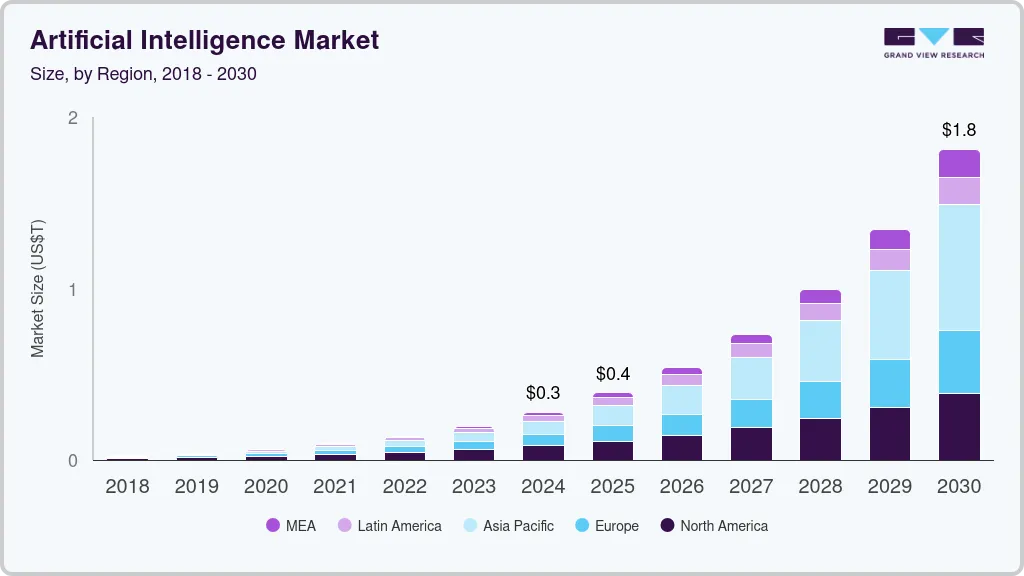
The AIOps platform market reached $2.67 billion in 2026, according to Fortune Business Insights, and is projected to grow to $11.8 billion by 2034 at a compound annual growth rate of 20.40%.
That estimate reflects a conservative, narrowly-defined AIOps scope — platforms specifically built for IT operations intelligence. Broader market definitions produce substantially higher figures:
- Mordor Intelligence sizes the market at $18.95 billion in 2026, growing to $37.79 billion by 2031 (14.80% CAGR), using a wider definition that includes adjacent IT automation categories
- Forrester Research (via IBM secondary reference) estimated the intelligent operations market would grow from $30 billion in 2021 to $94 billion in 2026, using an even broader scope that includes all AI-augmented IT workflows
- The broader AI automation market — covering all AI automation, not just AIOps — is tracked at $169.46 billion in 2026, with a 31.4% CAGR toward $1.14 trillion by 2033
How Different Analyst Firms Define and Size the Market
The divergence in market size estimates is not an error — it reflects genuine definitional disagreement. Fortune Business Insights and Gartner use the narrowest definition (platforms specifically doing ML-based event correlation and root cause analysis for IT ops). Forrester and IDC include AIOps within a broader "intelligent operations" frame that encompasses ITSM automation, self-healing systems, and agentic AI for DevOps.
For practitioners evaluating platform ROI, the relevant number is not the total addressable market figure — it's the enterprise AI spend benchmark. Gartner projects $2.52 trillion in worldwide AI spend in 2026, signaling that budget allocations for AI tooling across enterprise IT have expanded dramatically.
North America holds 37.5% of the global AIOps market as of 2025 and remains the largest region by revenue (Fortune Business Insights). Asia-Pacific is the fastest-growing region, with a 16.22% CAGR through 2031.
The healthcare vertical is growing at a 16.66% CAGR through 2031 — driven by strict uptime requirements for patient-facing systems, regulatory compliance pressure, and the high cost of unplanned downtime in clinical environments.
AI-Powered Monitoring Adoption: Enterprise Pace in 2026
Adoption of AI-powered monitoring climbed from 42% to 54% of enterprises between 2024 and 2025, according to Mordor Intelligence — a 12-percentage-point jump in a single year that reflects both increased IT budgets and more mature platform options.
- 72% of enterprises have at least one AI workload in production as of Q1 2026 (McKinsey Global AI Survey 2026 via CXOVoice)
- Forrester: 51% of organizations are currently adopting AIOps-style intelligent monitoring, with 21% intending to within the next year (via IBM Think)
- Gartner: 50% of large enterprises will integrate AIOps to streamline IT processes by 2026 (via Solulab)
- 67% of Managed Service Providers (MSPs) now offer AI-powered monitoring services as part of their standard service catalog (Datto/Kaseya Global MSP Report 2026 via Medha Cloud)
Automation investment is extending deeper into core IT infrastructure:
- IDC expects AI copilots to be embedded in nearly 80% of enterprise workplace applications by 2026 (via Medha Cloud)
- 90% of large enterprises list hyperautomation as a strategic priority (via AI Multiple Research)
- 30% of enterprises will automate more than half of their network activities by 2026, up from less than 10% in mid-2023 (Gartner, via AI Multiple Research)
Enterprise vs. SMB Adoption Rates
Adoption is not uniform across organization sizes. Large enterprises (5,000+ employees) report an 83% AI deployment rate versus just 42% for firms with 50–499 employees, according to the Writer Enterprise AI Adoption Survey 2026. This disparity reflects infrastructure complexity (larger organizations have more telemetry to manage, stronger ROI justification) and capital availability for platform licensing.
Meanwhile, Gartner's historical tracking shows large enterprises' exclusive AIOps use for monitoring growing from 5% in 2018 to 30% in 2024 — a pattern that suggests mainstream adoption is still early-to-mid cycle rather than saturated.
Industry Adoption Leaders: Telecom, Healthcare, Finance
Telecom leads adoption because network operations centers (NOCs) were early AIOps environments by necessity — managing thousands of network elements across geographies at scale was always a data problem before it became an AI problem.
Healthcare is the fastest-growing vertical (16.66% CAGR) due to the intersection of uptime criticality, HIPAA compliance monitoring requirements, and rapid digital transformation of clinical infrastructure.
Financial services organizations use AIOps primarily for transaction processing monitoring, fraud signal correlation, and regulatory reporting pipelines — areas where downtime carries direct revenue and compliance cost.
AIOps Performance: MTTR, Alert Noise, and Uptime Data
This section contains the benchmark data most commonly cited in business cases for AIOps investment. All ranges reflect documented outcomes from enterprise deployments; individual results vary based on environment complexity, baseline tooling quality, and implementation maturity.
MTTR (Mean Time to Resolve) improvements:
- 40–60% MTTR improvement across enterprise AIOps deployments — the most consistently documented performance range in the literature (OpenObserve, AIOps Community)
- 70–90% reduction in incident investigation time — reflecting the shift from manual log correlation to automated root cause identification (IR.com / Splunk)
- 73% improvement in MTTD (Mean Time to Detect) in AIOps + SRE integration frameworks (ResearchGate academic study)
- 47% reduction in SRE on-call burden reported after AIOps implementation (DevOps.com)
Alert noise reduction:
- 80–90% alert volume reduction via intelligent event correlation — the capability that most directly addresses alert fatigue (OpenObserve research)
- 87% alert noise reduction specifically measured in AIOps + SRE integration contexts (ResearchGate)
- 62% of common infrastructure issues are auto-resolved without human intervention in mature AIOps + SRE deployments (ResearchGate)
Incident reduction and uptime:
- 15–45% reduction in high-priority incidents after AIOps and proactive monitoring implementation (IR.com)
- AIOps platforms can predict server failures up to 72 hours before occurrence, enabling proactive maintenance scheduling (LogicMonitor documentation)
- Organizations typically cut IT costs by up to 40% through AIOps-driven operational efficiency (Solulab AIOps Implementation Guide 2026)
Real-World MTTR Reduction Case Studies
BT Group (UK Telecom): Reduced MTTR from 2 hours to 85 seconds using AIOps — a 96% reduction in resolution time for network incidents (IR.com).
HCL Technologies (Global IT Services): Deployed Moogsoft AIOps across its IT operations and achieved a 33% MTTR reduction, consolidated 85% of event data into a single correlated view, and reduced help-desk tickets by 62% (Medium / AIOps case study compilation).
CMC Networks (62 countries, network operations): Implemented BigPanda AI event correlation and achieved a 38% reduction in Mean Time to Repair across its multinational NOC (BigPanda case study).
Meta (DrP internal tool): Meta's internal AI diagnostics tool runs 50,000 analyses daily across 300+ engineering teams, with measured MTTR reductions in the 20–80% range depending on incident type (incident.io industry coverage).
SLA Compliance and Uptime Improvements
Cambia Health Solutions provides the clearest SLA improvement data available: after deploying BigPanda AIOps, 83% of alerts were handled automatically without human intervention, and the organization achieved 95% SLA compliance — up from a baseline where manual triage was the norm (BigPanda case study).
The business case behind the numbers: IT downtime costs an average of $14,056 per minute across industries, rising to $23,750 per minute for large enterprises (Solulab, multiple citations). At those rates, even a modest MTTR improvement from 60 minutes to 40 minutes saves $280,000 per incident at enterprise scale.
Top AI Operations Automation Tools in 2026: Ratings
The leading AI operations automation tools in 2026, ranked by G2 and Gartner Peer Insights rating:
- Dynatrace — Causal AI engine (Davis) for enterprise root cause analysis; 4.6 stars, 1,745 reviews
- Datadog — Cloud-native unified observability with 650+ integrations; 4.5 stars, 868 reviews
- Splunk (Cisco) — SIEM-integrated event correlation and security-focused IT ops
- ServiceNow ITOM — ITSM-native IT operations management for ServiceNow-invested organizations
- New Relic — Full-stack observability with open telemetry and consumption-based pricing
- BigPanda — AI event correlation hub aggregating alerts from 5–15 monitoring tools
- IBM Turbonomic — Automated resource optimization and workload management
- Elastic Observability — Open-source AIOps on the Elastic Stack with no vendor lock-in
Choosing the right AI operations automation tools requires understanding how each platform performs on the metrics that matter — causal AI accuracy, ecosystem breadth, and integration depth. The table below summarizes the leading platforms by G2/Gartner Peer Insights rating, primary differentiator, and best-fit use case. Data sourced from G2's AIOps category and Gartner Peer Insights.
| Tool | G2/Gartner Rating | Best For | Key Capability | Pricing Model |
|---|---|---|---|---|
| Dynatrace | 4.6 stars (1,745 reviews) | Large enterprise causal AI | Davis Causal AI engine; root cause with low false positives | Subscription; complex licensing |
| Datadog | 4.5 stars (868 reviews) | Agile cloud-native teams | Broadest integration ecosystem; unified logs/metrics/traces | Usage-based; costs scale with data volume |
| Splunk (Cisco) | Not separately listed | SIEM + security event correlation | Advanced search; real-time data indexing; security focus | Storage-based; can become expensive at scale |
| ServiceNow ITOM | Strong enterprise presence | ITSM-integrated operations | CMDB depth; workflow automation; ITSM ecosystem lock-in | Enterprise licensing |
| New Relic | Strong on G2 | Full-stack dev observability | Open telemetry; consumption-based pricing | Pay-per-data-ingestion |
Dynatrace — Best for Causal AI and Enterprise Automation
Dynatrace earns the highest Gartner Peer Insights rating in the AIOps category at 4.6 stars across 1,745 reviews. Its core differentiator is Davis — a causal AI engine that determines exact cause-and-effect relationships across distributed systems rather than surfacing probabilistic correlations. Davis consistently scores highest on root cause identification (90%), systems monitoring (89%), and alerting (88%) in G2 feature ratings.
Limitations include: a high learning curve for first-time users, a complex licensing structure that makes budgeting difficult, and pricing that becomes expensive at large-scale deployments. Teams without dedicated Dynatrace expertise often struggle with initial configuration.
Datadog — Best for Cloud-Native Ecosystem Breadth
Datadog's 4.5-star rating across 868 Gartner Peer Insights reviews reflects consistent performance across diverse cloud environments. Its primary advantage is ecosystem breadth: Datadog integrates with more technologies than any other platform in the AIOps category, and its unified view of logs, metrics, and distributed traces reduces context-switching for engineering teams.
Limitations include: usage-based pricing that can spike unpredictably at scale, and feature costs that accumulate quickly as teams add capabilities. Organizations with unpredictable telemetry volumes report difficulty forecasting Datadog costs month-to-month.
Splunk (Cisco) — Best for SIEM and Security Correlation
Following Cisco's acquisition, Splunk's position in the AIOps market increasingly emphasizes its SIEM (Security Information and Event Management) capabilities alongside traditional IT ops monitoring. Its advanced search functionality and real-time data indexing are benchmarks others target.
Limitations include: storage costs that some organizations describe as prohibitive, manual configuration requirements that prevent fully automated operation, and complex initial setup. In practice, Splunk handles well where security event correlation and compliance reporting matter most.
ServiceNow ITOM — Best for ITSM-Integrated Operations
ServiceNow IT Operations Management integrates directly with ServiceNow's ITSM platform — the primary differentiator for organizations already using ServiceNow for ticketing, change management, and asset tracking. The CMDB depth and workflow automation capabilities are strongest-in-class for this integration scenario.
Limitations include: high dependency on the broader ServiceNow ecosystem; organizations not already invested in ServiceNow face significant onboarding complexity.
New Relic — Best for Full-Stack Observability
New Relic provides full-stack observability with open telemetry support — meaning it can ingest data from any source without vendor lock-in on instrumentation. Its consumption-based pricing model is appealing to development teams with predictable data volumes.
Limitations include: pricing complexity at scale (data ingestion costs) and a feature set that, while broad, may not match Dynatrace's causal AI depth for complex enterprise environments.
Selection Criteria: AI Operations Automation Tools
| Criteria | Dynatrace | Datadog | Splunk | ServiceNow ITOM | New Relic | BigPanda |
|---|---|---|---|---|---|---|
| Best for | Enterprise causal AI | Cloud-native teams | SIEM + security ops | ITSM-invested orgs | Full-stack dev observability | Multi-tool alert correlation |
| Pricing model | Subscription (complex) | Usage-based | Storage-based | Enterprise license | Consumption-based | Enterprise license |
| Open source option | No | No | No | No | No | No |
| No-code automation | Partial | Yes | Partial | Yes | Partial | Yes |
| AI root cause analysis | Davis AI (best-in-class) | AI-assisted | ML-augmented | Rule + ML hybrid | ML-based | Correlation AI |
| Integrations | 600+ | 650+ | Extensive | ServiceNow native | 500+ | 200+ monitoring sources |
| Best environment | Hybrid / on-prem | Cloud-native | Enterprise / security | ServiceNow shops | Cloud / dev-centric | Multi-vendor NOC |
For a broader view of AI tools across categories, see Calliber's AI tools coverage.
IT Automation Trends Shaping Operations in 2026
The platforms above are evolving rapidly. These are the four trends that will define AI operations automation tools development through 2026 and into 2027. Understanding these trends helps teams select AI operations automation tools that will remain competitive as the market shifts.
Agentic AI and Multi-Agent Systems
The shift from reactive AI (surface an alert) to autonomous AI (investigate, diagnose, and remediate without human intervention) is the defining technical trend of 2026. Gartner predicts AI agents will challenge mainstream productivity tools by 2027, driving a $58 billion market shift in how enterprises configure and use AI tooling (Gartner via Gartner Peer Insights).
More specifically: Gartner forecasts 40% of enterprise applications will include task-specific AI agents by end of 2026 — up from fewer than 5% in 2025. In AIOps terms, this means monitoring systems that don't just detect anomalies but initiate runbook execution, coordinate across multiple infrastructure layers, and report back with resolution status.
Self-Healing Infrastructure
Self-healing infrastructure — where the system identifies a failure and corrects it autonomously — is transitioning from experimental to mainstream in 2026, according to the Motadata AIOps Trends Report 2026. In practice, this takes the form of automated pod restarts in Kubernetes environments, auto-scaling triggers based on predicted demand rather than threshold breach, and automated certificate renewal before expiration events.
The enabling capability is AIOps' predictive modeling: platforms now predict server failures up to 72 hours before occurrence (LogicMonitor), providing the lead time needed for proactive remediation rather than reactive recovery.
Low-Code/No-Code AIOps Democratization
Platform complexity has historically limited AIOps adoption to organizations with dedicated ML engineering resources. That barrier is lowering. Gartner estimates organizations will build 70% of new technology products using low/no-code platforms (via AI Multiple Research), and AIOps vendors are shipping no-code automation workflow builders to capture mid-market buyers.
IDC expects AI copilots to be embedded in nearly 80% of enterprise workplace applications by 2026 (via Medha Cloud). In IT operations specifically, this means non-ML-expert IT administrators will have conversational interfaces to query system state, trigger investigations, and configure alert policies.
Natural Language IT Operations Interfaces
By 2026, IT teams are managing systems using AI chat assistants with natural language interfaces for queries and remediation (Motadata AIOps Trends Report 2026). The workflow: instead of writing a complex query language statement to investigate log data, an on-call engineer types "show me all errors in the payment service in the last 30 minutes with CPU > 80%" and gets an immediate visualization.
This shift directly addresses the 58% of IT teams who struggle to interpret ML outputs — natural language interfaces abstract away ML complexity without reducing the underlying analytical power.
For additional context on workflow automation in AI teams, see Calliber's guides section.
The 2026 AIOps Adoption Paradox: More Tools, More Toil?
The most counterintuitive finding in 2026 AIOps research is this: despite increased investment in AI operations automation tools, manual toil for engineers has increased by 30% compared to 2024, according to industry data from OpenObserve.
The cause is not AI tools failing — it's what happens when organizations buy multiple unintegrated AI tools. Most enterprises in 2026 run 5–15 monitoring tools that each generate their own alerts, dashboards, and data formats (The CTO Club). When those tools don't share context with each other, engineers must manually correlate signals across platforms — exactly the problem AIOps is designed to solve.
The paradox has a name in the industry: "tool sprawl." An organization running Datadog for infrastructure, Splunk for security events, ServiceNow for ticketing, and a separate APM tool for application performance monitoring can end up with four alert streams that each require human routing before any investigation begins.
IT teams spend 70% of their time on repetitive tasks and time-consuming activities, according to the Global State of IT Automation Report 2026 from Stonebranch — and only 21% of organizations run AI workflows at enterprise scale despite widespread tool purchases.
The implication for practitioners: purchasing an AIOps platform is not sufficient. Integration architecture — ensuring all monitoring tools feed into a single correlation layer — determines whether AI investment reduces or inadvertently increases operational burden.
AIOps Challenges: Skills Gaps, Integration, and Oversight
The Skills Gap Crisis in AI Operations
63% of organizations report a shortage of professionals skilled in AI-driven IT operations, according to multiple industry surveys cited by Motadata. The specific gap is not just AI knowledge — it's the intersection of AI/ML literacy, deep IT infrastructure expertise, and knowledge of the specific AIOps platform deployed.
58% of IT teams struggle to interpret ML outputs even when AIOps tools are already deployed (Motadata). The platforms generate sophisticated analysis; the problem is that many IT operations teams lack the statistical foundation to evaluate model confidence or distinguish meaningful anomalies from noise.
79% of organizations face AI adoption challenges in 2026 — a double-digit increase from 2025, per the Writer Enterprise AI Adoption Survey 2026. Skill availability is consistently ranked among the top three challenges alongside data quality and integration complexity.
AI super-users — professionals who have developed fluency with AI tooling — save nearly 9 hours per week, which is 4.5x more than AI laggards (BCG / Writer 2026 surveys). This productivity gap is widening, creating internal pressure to accelerate AI skills development even as external hiring for those skills remains difficult.
Integration Complexity: Managing Multiple Tools
41% of enterprises identify legacy system integration as their primary AIOps adoption barrier, according to Datacouch research. The specific challenge: modern AIOps platforms require telemetry from every layer of the IT stack — infrastructure, applications, logs, security events, and business KPIs. Integrating those data streams in organizations with 10-20 years of legacy infrastructure requires significant engineering effort.
The tool count problem compounds this: most enterprises run 5–15 monitoring tools simultaneously (The CTO Club). Each tool was acquired to solve a specific problem; collectively, they create an integration challenge that often requires a dedicated platform engineering team to manage.
Governance and Oversight: AI Agent Control Maturity
As AIOps platforms gain autonomous remediation capabilities — executing runbooks, scaling resources, routing incidents — the governance question becomes critical. Only 21% of companies have mature governance models for autonomous AI agents, according to Deloitte's State of AI in the Enterprise 2026.
The governance gap creates specific risks: autonomous remediation actions that conflict with change management policies, AI-driven infrastructure scaling that exceeds budget guardrails, and automated incident resolution that masks underlying architectural problems rather than surfacing them for engineering review.
Organizations deploying agentic AIOps capabilities in 2026 should establish explicit policies for which remediation actions require human approval, maintain audit logs of all AI-initiated changes, and define confidence thresholds below which alerts escalate to human review rather than auto-remediate.
For coverage of AI governance frameworks, see Calliber's AI news section.
What's Next: AIOps Predictions for 2027 and Beyond
The trajectory of the data points toward several near-certain developments for 2027 and the following years:
1. Agentic AIOps becomes standard, not premium. Gartner's prediction that 40% of enterprise applications include AI agents by end of 2026 sets the foundation. By 2027, AIOps platforms without autonomous remediation capabilities will lose market position to those that offer it as a default capability rather than an add-on.
2. The tool consolidation wave accelerates. The 2026 paradox — more tools, more toil — will drive purchasing decisions toward unified observability platforms that replace multi-vendor stacks. Vendors like Dynatrace, Datadog, and New Relic are all building toward this; the consolidation pressure will intensify.
3. Edge AIOps becomes production-ready. As enterprise infrastructure distributes further toward edge computing and 5G-connected IoT, AIOps platforms will extend their correlation capabilities to edge nodes — managing latency, connectivity, and compute constraints in environments where centralized monitoring has inherent delay.
4. AI governance regulations reach IT operations. Regulatory pressure on AI decision-making (EU AI Act, emerging US frameworks) will drive audit and governance requirements into AIOps tooling. Organizations running automated remediation without audit trails will face compliance risk — accelerating demand for governance-native AIOps features.
5. Low-code AIOps democratizes mid-market adoption. The skills gap (63% of organizations lack qualified staff) combined with no-code platform development will push AIOps into organizations that previously could not deploy it — extending the market's total addressable base significantly below the current large-enterprise core.
For ongoing coverage of AI automation trends, see Calliber's comparisons section.
AIOps Statistics Summary Table
| Metric | Statistic | Source |
|---|---|---|
| AIOps market size (2026) | $2.67 billion | Fortune Business Insights |
| AIOps market projection (2034) | $11.8 billion | Fortune Business Insights |
| Market CAGR | 20.40% | Fortune Business Insights |
| Enterprise AI adoption | 72% have AI in production | McKinsey 2026 |
| AIOps monitoring adoption | 54% of enterprises | Mordor Intelligence |
| MTTR improvement (typical) | 40–60% | OpenObserve research |
| Alert volume reduction | 80–90% | Industry case studies |
| Skills gap | 63% lack qualified staff | Industry surveys |
| Manual toil increase (paradox) | 30% despite AI investment | OpenObserve 2026 |
| Mature AI governance | Only 21% of companies | Deloitte 2026 |
| Enterprise AI deployment rate (large) | 83% | Writer Survey 2026 |
| Enterprise AI deployment rate (SMB) | 42% | Writer Survey 2026 |
Frequently Asked Questions About AIOps Statistics
What is AIOps and how does it work?
AIOps (Artificial Intelligence for IT Operations) uses machine learning and big data analytics to automate IT monitoring, anomaly detection, and incident response. It ingests telemetry from multiple IT systems, applies ML to correlate events and identify root causes, and triggers automated remediation — replacing manual log correlation that would otherwise take hours.
What is the AIOps market size in 2026?
The AIOps platform market is valued at approximately $2.67 billion in 2026 according to Fortune Business Insights, growing to $11.8 billion by 2034 at a 20.40% CAGR. Broader estimates from Mordor Intelligence ($18.95 billion) and Forrester ($94 billion) reflect wider definitions that include adjacent IT automation categories.
How does AIOps reduce MTTR?
AIOps reduces MTTR by automating root cause identification that would otherwise require manual log correlation. The typical documented improvement range is 40–60% MTTR reduction. Real-world examples include BT Group (from 2 hours to 85 seconds), HCL Technologies (33% MTTR reduction), and CMC Networks (38% reduction). The mechanism: instead of an engineer manually reviewing logs from 5–15 monitoring tools, the AIOps platform correlates all telemetry and surfaces a single prioritized root cause diagnosis.
What are the main challenges of implementing AIOps?
The three primary AIOps implementation challenges are integration complexity, skills gaps, and governance maturity. Specifically: 41% of enterprises cite legacy system integration as their top barrier; 63% of organizations lack staff skilled in AI-driven IT operations; and only 21% of companies have mature frameworks governing autonomous AI agents. Tool sprawl — running 5–15 disconnected monitoring tools — amplifies all three.
What are the top AIOps tools in 2026?
The leading AI operations automation tools by G2 and Gartner Peer Insights rating are Dynatrace (4.6 stars), Datadog (4.5 stars), Splunk (Cisco), ServiceNow ITOM, and New Relic. Dynatrace leads on causal AI precision; Datadog leads on ecosystem breadth; Splunk (Cisco) leads on SIEM and security event correlation; ServiceNow ITOM suits organizations already in the ServiceNow ecosystem; New Relic leads on full-stack observability with open telemetry. Selection should be based on environment type, team expertise, and integration requirements — not rating alone.
How does AIOps differ from traditional IT monitoring?
Traditional monitoring uses static thresholds to trigger alerts when a metric exceeds a defined limit. AIOps uses ML models trained on historical data to detect anomalies that static thresholds would miss, correlate related events across systems into a single incident, predict failures before they occur, and trigger automated remediation. Traditional monitoring generates 500–1,200 alerts per day in complex environments; AIOps can reduce that to 50–120 actionable signals through intelligent event correlation.
What percentage of companies use AIOps in 2026?
Approximately 51% of organizations are currently adopting AIOps-style intelligent monitoring, per Forrester, with 21% intending to adopt within the next year. Gartner's narrower definition shows 30% of large enterprises exclusively using AIOps for monitoring as of 2024, up from 5% in 2018. The AI-powered monitoring adoption rate (a broader measure) stands at 54% of enterprises as of 2025.
Does AIOps continuously learn and adapt?
AIOps platforms use continuously trained ML models that improve as they ingest more operational data — meaning performance gains compound over time rather than plateau. Anomaly detection models update baselines as infrastructure evolves; root cause analysis models improve as resolution data feeds back into the training loop. This continuous learning is what distinguishes AIOps from static rule-based monitoring.
What are open-source AI operations automation tools?
Open-source AI operations automation tools are AIOps platforms with publicly available source code that teams can deploy, customize, and extend without commercial licensing costs. Elastic Observability (built on the Elastic Stack) provides unified logs, metrics, and traces with native ML anomaly detection. Netdata offers real-time, high-resolution infrastructure monitoring with distributed anomaly detection at no licensing cost. These open-source options suit organizations with strong DevOps engineering capacity that need cost flexibility or require full data sovereignty — though they typically require more internal expertise to operate than commercial platforms.
How do I choose AI operations automation tools?
Choosing the right AI operations automation tools depends on four factors: environment type, team expertise, integration requirements, and governance needs. Cloud-native environments favor Datadog's ecosystem breadth; complex on-premise/hybrid deployments favor Dynatrace's causal AI depth. Organizations without dedicated ML engineers should prioritize platforms with natural language interfaces and no-code automation builders. The platform must ingest telemetry from your existing monitoring stack without creating a new silo — and if you're running autonomous remediation, audit trail and approval workflow capabilities are non-negotiable. G2 or Gartner Peer Insights ratings are useful but incomplete — the highest-rated tool for one environment may underperform in another.
Conclusion
The 2026 AIOps landscape is defined by a clear tension: adoption is accelerating, performance benchmarks are well-established, and the business case is proven — yet integration complexity, skills gaps, and governance immaturity mean that tool purchases alone do not guarantee outcomes. The organizations seeing 40–60% MTTR improvements are those that treat AIOps as a platform architecture decision, not a point solution purchase.
The next step for teams evaluating AI operations automation tools is to assess their current monitoring stack integration posture: how many tools generate alerts today, whether those alerts flow into a single correlation layer, and whether the team has the ML literacy to interpret and act on AI-generated insights. That assessment — not vendor ratings — determines which platform will deliver ROI.
For ongoing analysis of AI operations tools, comparisons, and adoption data, see Calliber's AI tools coverage.
Get the weekly
One essay + 3 tools worth your attention, every Tuesday.
you@company.com